
Exclusive interview with yokozuna Akebono - Monthly Playboy (August 1993)

First in a five-part series
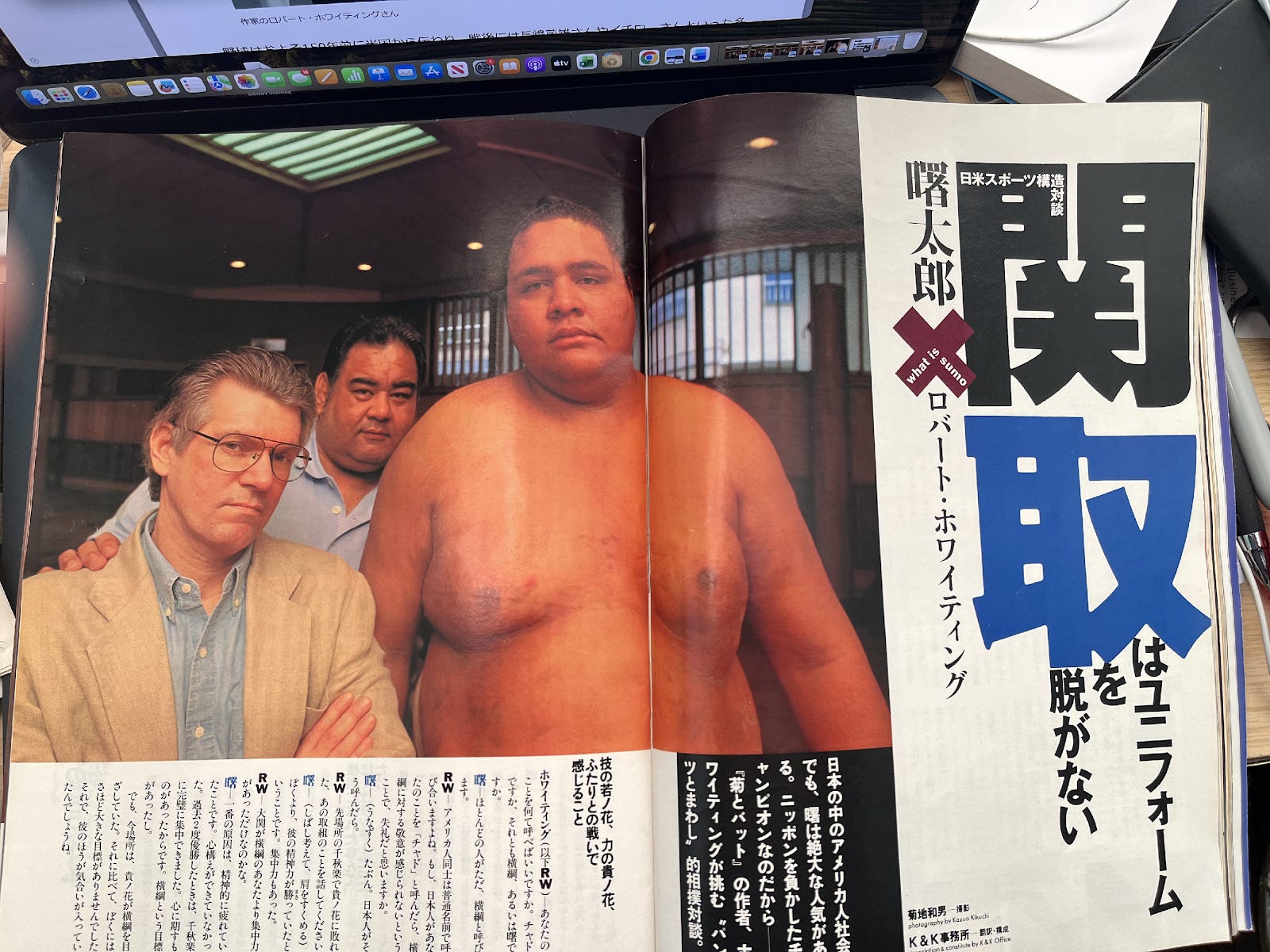
TOKYO — Akebono Taro, born Chadwick Haheo Rowan, was the first non-Japanese born wrestler ever to reach the rank of yokozuna or grand champion, the highest rank in Japan’s ancient sport of sumo. He did this after winning two consecutive tournament championships in November 1992 and January 1993, having joined sumo in 1988 and training under pioneering Hawaiian wrestler Takamiyama (Jesse Kualahula).
Born, May 8, 1969, in Waimanalo, Hawaii, Akebono, at 6’8” and 514 pounds was one of the tallest and heaviest wrestlers ever. His rivalry with young pedigreed sumo stars like teen idol Takanohana and his elder brother Wakanohana helped to ignite a sumo boom. Akebono won 11 tournaments and was runner-up on numerous other occasions, including 13 times as a yokozuna.
After retiring in January 2001, Akebono had a brief career in K-1 boxing, followed by a much more successful career in professional wrestling. He passed away in 2024.
The following interview took place at the Azumazeki stable on May 25, 1993, and was published in the Weekly Playboy Gekkan in its August issue that year.
PART I
Q: How long did it take you to become fluent in Japanese?
A: A year and a half.
Q: Studying every day?
A: No I just picked it up in the stable.
Q: Can you read it? Have you studied kanji?
A: I can write my own name. That’s about it.
Q: How am I supposed to address you? Chad? Rowan-san? Akebono? Yokozuna?
A: Most people just call me yokozuna.
Q: From the time you were promoted to that rank, people switched from calling you ozeki (junior champion)
A: They called me Akebono.
Q; If a Japanese called you “Chad “ would you think that it was rude — given the respect that a yokozuna is supposed to be shown?
A: (nods) Yes. Maybe. If a Japanese called me that.
Q: Do you have a name card, or meishi? Does it say “Akebono, yokozuna”?
A; No (laugh) no name card.
Q; Let’s talk about the last tourney. You have a very good record. But you lost on the last day to your archrival. Tell us your thoughts about that last match.
A: (Pauses, thinks, shrugs) He just had more mental power than I had. His concentration was better.
Q: If you could fight that match over, would you do anything differently?
A: No. He just had better concentration. That’s all.
Q: You had a fever at the beginning of the tournament, didn’t you? You were taking IV treatments.
A: I had a fever from the third day to the seventh. But more important, I wasn’t mentally psyched up. This was different than in other tournaments. When I won a yusho, the last two times, I was able to concentrate fully on he last day because there was something at stake. I was aiming to become a yokozuna. But this time, Takanohana was the one aiming to make yokozuna. There was nothing that big on the line for me. So you could say he had more motivation that I did.
Q: So you mean you didn’t feel any pressure to win this last time? You felt you could relax a little bit.
A: I did my best to win. But Taka was just more psyched up than I was. He just wanted it more. Also I’m still in the middle of the learning process., I’m learning how to be a yokozuna.
Q: What do you mean. What are you learning?
A: How to pace myself. In the beginning of the tournament, I went all out against each opponent. But by the end of the tournament, I was mentally weak. I had a lack of focus and concentration. I think I have to practice harder.
Q: How do you fix mental weakness?
A: Practice. Practice harder. That’s the only way I know how to fix the problem.
Q: Tell me what it is like for you before a big match for the tourney championship. What was your day like before you climbed up into the ring to face Takanohana? Did you obsess over the upcoming match?
A: No I just keep to my regular day routine, I get up and practice in the morning, take a shower. Rest, eat. Watch the preliminary matches on TV and I think about what I want to do in my own bout. I imagine in my mind what the match will be like. I try to envision the match turning out as I want it to.
Q: That’s “image training,”
A: Sort of. It’s a technique I learned in high school from my basketball coach. You imagine the game the way you want it to turn out. You imagine yourself making the moves you want to make., The theory is, if you imagine it, it will happen that way. That’s the theory anyway.
Q: Did you have any special strategy for the Takanohana match?
A: No, just the same thing I do every day against every opponent. Push him out.
Q: Are you usually nervous before matches?
A: This tournament I was very nervous. Previously, I had won three championships. I had won all of them on the last day and I wasn’t nervous at all. I just did what I had to do. But not this basho (tournament). My oyakata (stablemaster) was sitting at ringside. He was one of the judges. He told me that he took one last look at my face and he could tell I was real nervous. It was because of mental fatigue.
Q: What goes through your mind at the tachi-ai (initial charge)?
A: I try to keep telling myself to wrestle the way I wrestle in practice, to just think about going forward, pushing grabbing — to keep my knees going forward.
Q: You never think to stop and step aside and let your opponent fall over from his own momentum?
A: No
Q: You always try to push and thrust your opponent out? You always go forward?
A: Yes, at first.
Q: Then after that you go for the belt?
A; Yes, when necessary.
Q: What was going through your mind as you hit the dirt during your last loss to Takanohana. Were you saying ‘dammit” to yourself?
A: Half of me was thinking as I was falling backward, that the tournament was over. For me, this last tournament was a long tournament. Fifteen days of stress. So as I was falling backward, I was thinking, “Ah, it is finally over.” I was relieved. The other half of me was really mad that Takanohana beat me.
Q: What do you think of Takanohana as a wrestler? He is extremely popular with the girls because of his good looks and his family history — his uncle and his father were champion wrestlers with popular followings. Do you really think he has really improved as a wrestler as he made yokozuna? Or has he just gotten physically bigger? Or both?
Q: He has gotten beefier. He’s bigger around the chest. He is becoming a little harder to push. The previous two matches I had against him were not all that hard. But the last time, he seemed tougher. However, the one who has really grown physically stronger, compared to before, anyway, is his older brother Wakanohana. It has become much harder for me to get him off of me when he drives in at me. Before I could push him away. I’d use tsuppari to keep him away from me. But now, he holds on to my arm and I can’t shake him loose. What has really gotten stronger about Wakanohana is his lower body strength. It’s like he is planted in the ground — like a tree trunk.
Q: Which brother do you think is the better all around sumo wrestler?
A: They are both really good. As far as technique goes. I think Wakanohana is better. Strength-wise, his younger brother has the edge.
Q: Of the two, who would you rather fight on the last day for the Emperor’s Cup.
A: I don’t know. I guess Wakanohana, because of his rank, ozeki — he is trying for yokozuna. There is more of an incentive for him to win. The fans would be more excited about an Akebono-Wakanohana match. It helps the adrenalin flow faster.
Q: Have you ever worried you might seriously hurt an opponent in the ring?
A: Yes, sometimes. When I send someone flying out of the ring, I worry that he might land the wrong way and hurt himself. Or land on a soda can and cut himself. Or land on a fan and seriously injure the fan.
Q: Have you ever been scared in the dohyo (ring)?
A: One time. Last year in September after I had a leg injury in Nagoya, I came back to the dohyo the first time and someplace in the back of my mind I was thinking about how to protect or cover my legs, so they wouldn’t get hurt. I tried not to think about it, but I couldn’t help it.
Q: You saw the match between Konishiki and Wakanohana this last tournament when Wakanohana landed on his head. Doesn’t it take an awful lot of courage to do that? It seemed Wakanohana consciously landed on his head. He didn’t use his arm to break his fall because he didn’t want to touch down before Konishiki and lose the match.
A: One of the first things we are taught in sumo school is that when you fall, never stick your arm out because the weight of your body and your opponent’s body falling on your arm is enough to break it. There is a real danger of a broken arm.
Q: You can also get a concussion falling on your head.
A: That’s the chance you have to take.
Q: Have you ever lost your temper and gotten really angry in a match, wanting to smash the other guy?
A: Only once. When I was first coming up. In Kyushu, in a match against Kyokudozan. He slapped me in the face at the tachi-ai before I was ready. He slapped me hard and it really made me mad. We had to do the tachi-ai a second time. I was still angry and I tried to slap him back in revenge. I got so mad that I swung and missed. I spun around and he caught me from behind and he threw me out. (Laughs). That’s the only time I lost my temper and I wound up losing. You learn from things like that.
Q: Do sumo wrestlers intentionally try to make their opponents angry?
A: Well, they try to psyche them out so that they lose their composure and forget their strategy.
Q: How do you do that?
A: You give them an evil stare.
Q: Konishiki does that. But you don’t seem to.
A: I try to control myself. If I get too psyched up, I tend to beat myself. So I try to maintain some self-control.
Autographed copies of Robert Whiting’s books are available for purchase. These include Gamblers, Fraudsters, Dreamers & Spies, You Gotta Have Wa, Tokyo Underworld, The Meaning of Ichiro, Tokyo Junkie, The Chrysanthemum and the Bat. If you are interested in purchasing a book, please send an email to: robertwhitingsjapan@gmail.com
RIP Akebono! He was the best!!