
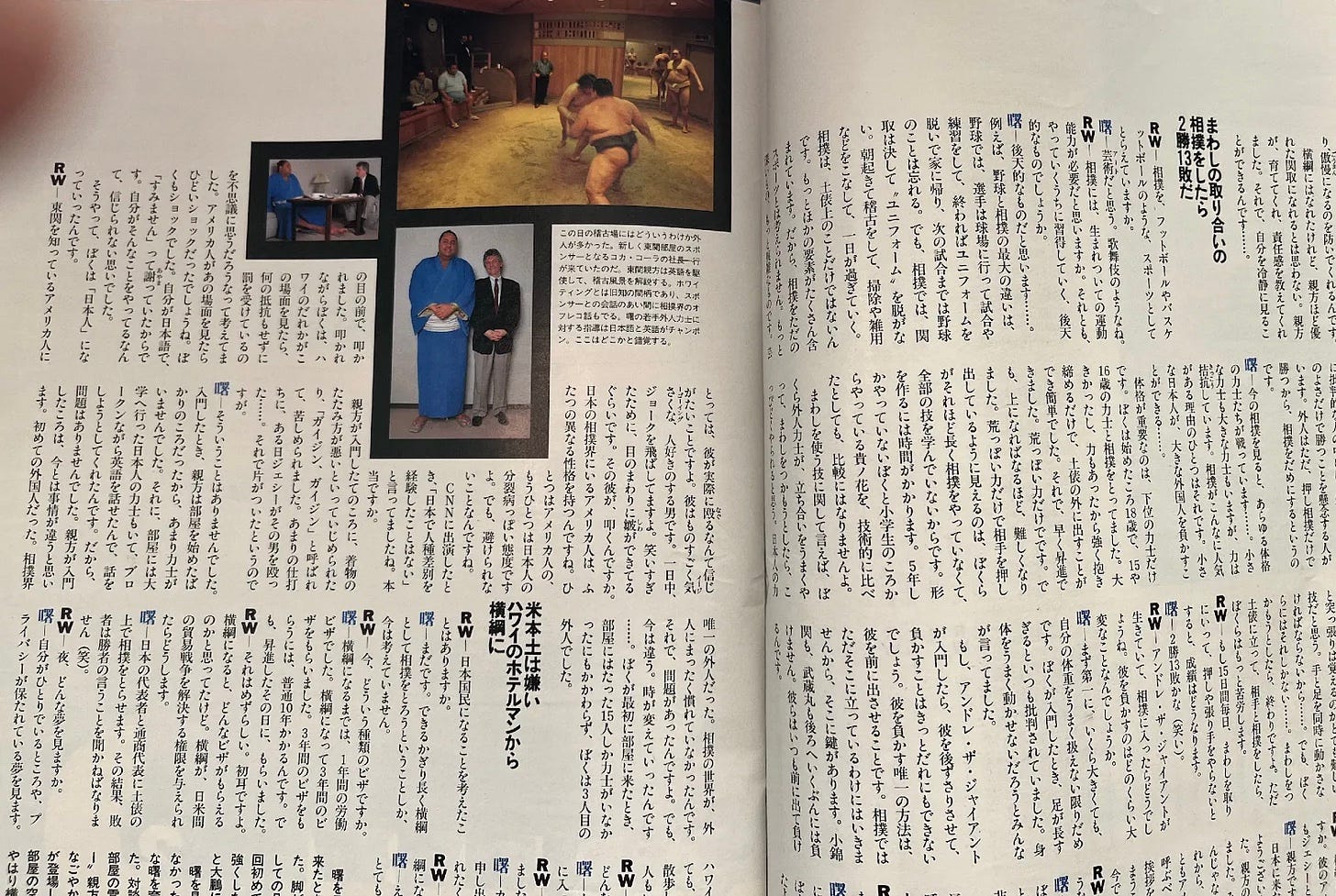
Exclusive interview with yokozuna Akebono - Monthly Playboy (August 1993) - Part 3

Third in a five-part series
Q: When you go to sleep at night what kind of dreams do you have?
A: I dream I am alone and that I have privacy. I dream I go back to Hawaii and lay alone on the beach and nobody notices. I walk by the sea and nobody comes up and bothers me. Right now sumo is very popular and everyone is always watching what I do. So I dream about peace and quiet.
Q: How did you feel when you first put on a mawashi? It’s certainly not something an ordinary American would ever wear. It’s like an elaborate jock strap with decorations.
A: In the beginning, it was uncomfortable. I was very embarrassed about wearing it. But I wasn’t the only person in Japan wearing one. There were hundreds of other Japanese wrestlers wearing them. I was also at the bottom of the sumo ladder. Nobody was going to look at me anyway.
Q: How did it feel, physically? Did it itch? Was it uncomfortable?
A: In the beginning, yes. But I’ve been wearing a mawashi for five years now. It has become a part of me. I’ve really gotten used to it, believe it or not. Now it feels better to me than wearing regular clothes.
Q: What were the hardest things about being a sumo wrestler for you in the beginning?
A: The hardest thing was the language. The second hardest thing was the subservience. When I came to sumo, I was 18 years old. Sixteen-year-old boys would yell at me, “Oi! Wash the dishes!” And I would have to do it. There would be this little kid, barely old enough to be a high school student, telling me, 18 years old, a high school graduate — an adult — to wash the dishes. I was physically stronger than him. I was better than him in practice. But still I would have to obey him. It was very, very difficult.
Q: In sumo, is it really true that the younger wrestlers have to help the older more obese ones in the toilet tidying up?
A: Some people might. But not me. I’ve never seen it. (Laugh)
Q: As an American, don’t you feel strange having attendants — lower-ranked wrestlers tsukebito (attendant), deshi (disciple) — around you all the time, serving you. Don’t you feel it’s undemocratic, even feudal?
A: In the beginning when I first made Juryo, I would go into the bath or the shower and I would tell the tsukebito, “You stay outside. I can wash myself.” I felt strange having them do it. In the beginning, I was always scolded by my oyakata because I treated my attendants more like friends instead of servants. But as you come up through the ranks, you learned to get used to be served. So now it has gotten to the point that if they are not around me, I don’t feel comfortable. I don’t feel right.
Q: Is knowing how to receive that kind of attention part of hinkaku to you?
A: Well, by accepting their attention, you develop a sense of responsibility toward them. You realize that even though some of them may not move up in the ranks as wrestlers, they still take care of you and they are a big part of the reason you are a success. One does not achieve success alone, so you always remember that they are people too and you have to take care of them. It’s a mutual responsibility.
Q: Did you ever hit a tsukebito?
A: Sometimes.
Q: You have? You are becoming Japanese.
A: Most the time when I hit somebody it’s during a tournament, when there is a lot of pressure and stress on me. So I will lose my temper and take it out on a tsukebito. I will slap them. It’s not just them. It is the whole stable — if they don’t do a proper greeting or show proper respect for the oyakata and the senior wrestlers, I’ll slap them. I warn them first. Then I’ll yell at them. But finally I’ll slap them, if they continue being disrespectful. The young kids these days in sumo, they are the worst offenders. They have to learn proper manners.
Q: You are the No. 1 sumo wrestler in Japan, as the only yokozuna. That also makes you the No. 1 sumo wrestler in the world. You occupy a position that no one else does. The “world champion of sumo.” Have you ever stopped to think about that?
A: (Embarrassed laugh. Shakes head). No.
Q: In a sense, you are like the heavyweight champion of the world. Or Hulk Hogan. This is an odd question, but how do you think you would do in the ring against a Riddick Bowe or a Mike Tyson, or the top professional wrestler in the world?
A: I don’t think you should make comparisons like that. I know what I had to go through to reach the top of the sumo world — all the hard work. And those guys had to do the same thing in their profession. I respect other athletes who are at the top of their fields. They didn’t just wake up one day and find themselves world champions. So I think out of respect for their accomplishments you should not compare sumo or pro wrestling or pro boxing.
Q: OK, let’s change the subject. What do you think of Takanohana’s new girlfriend —the popular young actress Rie Miyazawa that everyone is talking about. Is she your type?
A: (Laughs) She’s very beautiful.
Q: Were you surprised when she and Takanohana announced their engagement?
A: I was very glad for Takanohana when I heard that, because I think he had missed out on the best part of his life. He wasn’t able to have a life like a normal teenager or adolescent. It is hard to be 20 years old and be as popular — and as good looking — as he is. There is no privacy. He joined sumo when he was 15. Everybody was watching everything he did. By the time he was 20, he was an ozeki, the youngest in history. But he had lost out on his youth. So that’s why I was glad when I heard about his engagement to her. He had something of his own.
Q: I was under the impression that sumo wrestlers had a lot of freedom when it came to the opposite sex.
A: Not any more. There is too much media — the weekly magazines, et al, — watching everything you do. If I go out and have a few drinks, the magazines report it and people think I am an alcoholic. So I stay in my room most of the time. That’s how I stay out of trouble.
Q: That is really your life away from the ring? Staying in your room?
A: Yes. Most of the time I am in my room watching videos and listening to music. It is too much trouble going out, because I always have to watch what I do. The fans, the mass media are always watching me, especially so after becoming ozeki and then yokozuna. If I got caught doing the wrong thing, it would be a big disgrace to the rank of yokozuna.
Q: Don’t you ever have dates, then. I’ve seen photographs of you out with young ladies. You had a romance with the model Noriko Usui (who became a porn actress).
A: That’s why I stay in my room so I won’t get photographed with them anymore. My picture was in the magazines last year with some girl. I learned a big lesson from that experience. I learned you always have to watch out for the weekly magazines.
Q: You have a special girlfriend now?
A: No.
Q: No plans to get married in the foreseeable future?
A: No.
Q: I heard that Jesse, excuse me Azumazeki Oyakata, told you not to get married for a while. Not until you had firmly established yourself.
A: The oyakata got married when he was 28. I’m still 24. One year goes by so fast in sumo. By the time I get settled and comfortable with the rank of yokozuna in 2 or 3 years, I’ll be 27-28.
Q: Are there groupies in sumo? In the NBA, for example, they’re everywhere. MLB too. They line up outside the locker room after a game. They hang around the hotel lobbies. They pass the players their phone numbers or room keys. Is there anything like that in sumo?
A: Yes. People used to say that sumo is an old people’s sport. But not anymore. On jungyo tour, when we get off the train, there are a lot of people waiting, a lot of young girls who would give their phone numbers to the tsukebito to pass on.
Q: Were you surprised that Taka and Rie broke off their engagement?
A: Yes, somewhat.
Q: Have you ever talked to Takanohana about it?
A: No. You don’t talk about those things. That’s his private problem.
Q: Don’t you think it’s sort of sad? It was a fairy tale engagement and then to end like it did.
A: Yes, the reporters were following Takanohana all over the place. They would follow him around on tour, asking the same questions, over and over, everyday, about Rie. He must have been frustrated. I felt sorry for him.
Q: He also made the news by slapping a fan.
A: Yes, I was there. I felt like slapping him too — before Taka did it. I was ready to do it.
Q: Why? What happened?
A; We were walking to the ring for the opening ceremony. I was walking in front of Takanohana. I had just made ozeki. I was about five seconds in front of Taka. There were a lot of high school kids in the crowd. And out of the crowd, some kid burst out and slapped me — on the back. Hard. Bam. I stopped right there. I turned around. I didn’t know who it was. We couldn’t see right away. Then about five seconds later, the same thing happened to Takanohana. That’s why Taka hit him back.
Autographed copies of Robert Whiting’s books are available for purchase. These include Gamblers, Fraudsters, Dreamers & Spies, You Gotta Have Wa, Tokyo Underworld, The Meaning of Ichiro, Tokyo Junkie, The Chrysanthemum and the Bat. If you are interested in purchasing a book, please send an email to: robertwhitingsjapan@gmail.com